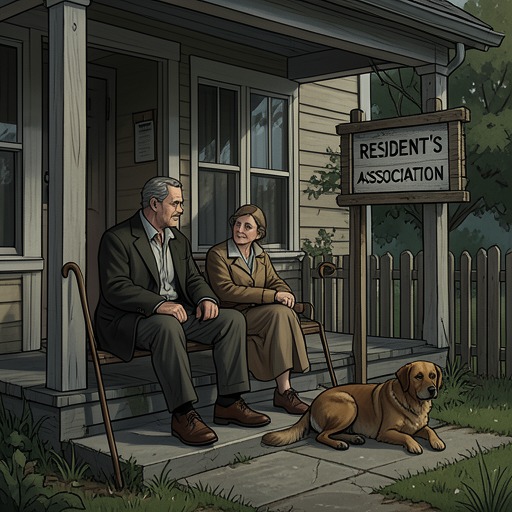
Neighbors stop Rune from being taken away by force
A Man Called OveThe neighbors’ intervention at Anita and Rune’s House stops Social Services from taking Rune away in that moment. The scene turns a private struggle over care into a collective confrontation: Anita insists that she will continue looking after her husband, while Ove, Parvaneh, and their neighbors stand with her. A journalist’s evidence of irregularities in care placements then shifts the encounter from a question of Anita’s capacity to a challenge to the officials’ own conduct. The officials leave, and the attempted removal is halted without the dispute being shown as permanently resolved.
Background and Stakes
The confrontation follows a period in which Rune’s illness has made everyday care more difficult. Earlier, Anita explained that he had Alzheimer’s and used a wheelchair. When Parvaneh offered Ove’s help with the radiators, Anita accepted with visible relief, while Ove initially questioned why Rune could not handle the repair himself. Once Anita explained his condition, Ove recognized that he had been reminded of information he had repeatedly forgotten. The exchange establishes both Rune’s dependence on care and the practical, neighborly assistance surrounding the household.
Later, Anita tells Ove that Social Services has again visited and wants to take Rune away from her. She says the agency considers her incapable of caring for him and believes he should live in a care home. Her account makes the conflict more than a disagreement about where Rune should live: the proposed placement threatens to separate a married couple and displace the care Anita has been providing. The scene does not offer a detailed assessment of Rune’s needs or the agency’s investigation. Instead, it places Anita’s account of the threatened separation against the authority of the official process.
The Attempt and Anita’s Refusal
The man in the white shirt returns about half an hour later with three young men in nurse uniforms. His group and the document he carries make the visit feel prepared for resistance, but the nurses appear uncomfortable when Anita opens the door. The official announces that the time has come and tries to enter. Anita positions herself across the threshold and refuses to move. The doorway becomes the immediate boundary over which the dispute is being conducted: the visitors claim authority to proceed, while Anita asserts her right and determination to keep caring for Rune at home.
Anita frames her refusal in terms of love and persistence. She challenges the idea that handing Rune over when care becomes difficult could count as love, and insists that she knows him even when his illness has impaired his awareness. When the official asks who will care for him, she answers that she will. Her response does not deny his illness; it contests the conclusion that illness makes institutional placement the only possible answer. The scene gives her decision emotional and practical weight through her direct opposition at the threshold, rather than through a claim that caregiving is easy.
Ove then declares that he will help care for Rune too. Parvaneh joins him, followed by Patrick, Jimmy, Anders, Adrian, and Mirsad, who speak together and press into the doorway. Their support changes the balance of the encounter. Anita is no longer facing the officials alone, and the question of care becomes a shared commitment among neighbors. The group does not present a detailed care plan in this scene; its immediate force lies in making clear that Anita has people prepared to help rather than leaving the official’s question unanswered.
Evidence and the Officials’ Withdrawal
Lena arrives with a voice recorder and identifies herself as a reporter from the local newspaper. She gives the man in the white shirt papers concerning patients handled by his section, including people placed in homes against their own or their families’ wishes. The documents describe irregularities and failures to follow rules or proper procedures in geriatric-care placements for which he had responsibility. This intervention redirects scrutiny: the official had arrived to assess Anita’s fitness to care for Rune, but the papers raise questions about the process and the conduct of the authority making that assessment.
Patrick adds that the neighbors also have the official’s bank statements, travel bookings, hotel stays, work-computer browsing history, and email correspondence. The scene presents these materials as leverage, not as findings that have already been established in court or a formal inquiry. Lena explains that media attention could make the section’s legal processes take months or longer, and suggests that leaving would be the easiest course. The account therefore supports a limited conclusion: the prospect of public scrutiny and delay weighs on the official’s decision to withdraw. It does not specify the content of the records or establish that they prove a particular offense.
The man in the white shirt leaves, followed by the three nurses. His departure ends the immediate attempt to take Rune from the house. Lena is pleased that the journalists’ presence has helped avert a fight, while Ove remains surprised by how readily the official turns away. The scene gives the neighbors’ stand a concrete short-term result, but it does not state what Social Services decides later, whether the proposed placement is formally canceled, or how Rune’s care is arranged thereafter.
Significance
The episode contrasts institutional authority with care grounded in long familiarity and practical presence. The official arrives with paperwork and a team; Anita answers with her knowledge of Rune, and the neighbors turn that commitment into a collective offer of support. The journalist’s documents add a second form of resistance by making the agency’s procedures themselves subject to examination. Neither personal devotion nor public scrutiny is presented as a full resolution of the difficulties of caring for Rune, but together they prevent an immediate decision from being carried out without challenge.
The scene also extends Ove’s movement from solitary irritation toward responsibility for others. Earlier he has been impatient with the request for help, yet here he publicly offers to share the care, and the people around him follow. The action is not framed as a technical solution to Rune’s illness; it is a refusal to let Anita face the threatened separation alone. Its decisive outcome is immediate and specific: when the officials depart, Rune remains with Anita rather than being taken away during this visit.